Lacquer, Patina, and Gold Leaf: Surface Finishing Techniques in Italian Cuisine Cabinetry
 \n\n
\n\n
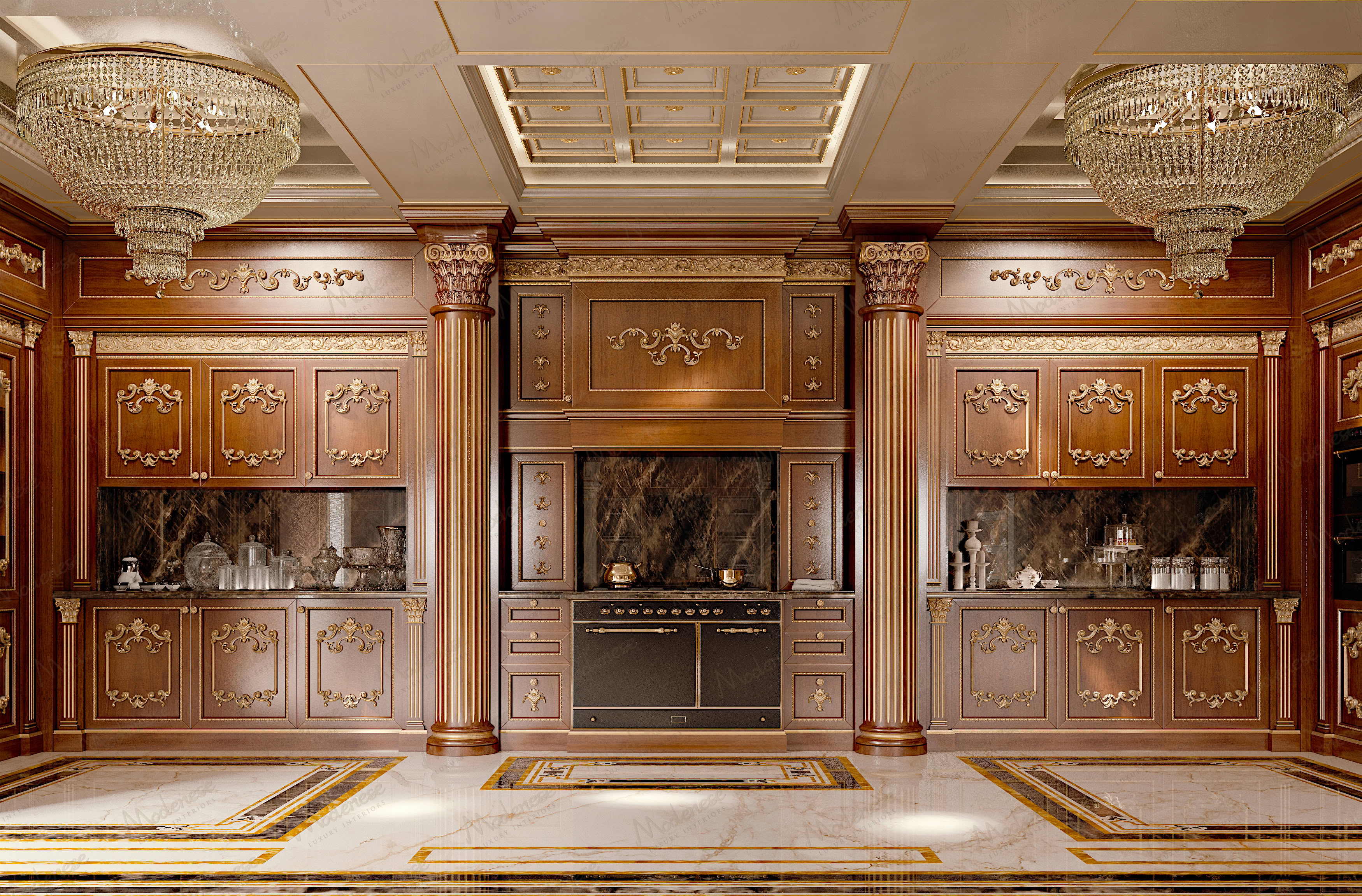
The surface finish on a kitchen cabinet determines how the piece looks on the day of installation, how it looks after fifteen years of daily use, and how much maintenance it requires in between. In Italian kitchen cabinetry, three finishing traditions — lacquer, patina, and gold leaf — each involve distinct materials, application methods, and long-term performance characteristics. At Modenese Bespoke, all three techniques are applied in-house, and the choice between them is driven by the specific conditions of each kitchen environment as much as by aesthetics.
Lacquer Finishing: Polyester vs. Polyurethane Chemistry and Application
Lacquer is the most widely used finish in high-end Italian kitchen cabinetry because it produces a sealed, non-porous surface that resists moisture, grease, and staining — the three primary threats in a kitchen environment. The two dominant lacquer chemistries in current use are unsaturated polyester (UP) and polyurethane (PU), and they differ in film thickness, hardness, repairability, and visual quality.
Polyester Lacquer
Polyester lacquer is a two-component system (resin plus catalyst) that cures through a chemical reaction rather than solvent evaporation. This allows it to be applied in thick coats — a single pass can deposit 200-400 microns of film, compared to 30-50 microns for most polyurethane systems. After curing (typically 24-48 hours at room temperature, accelerated with UV or infrared in industrial settings), the film is sanded flat through a progression of grits from 320 to 1500, then machine-polished with cutting compound and finished with a swirl remover to achieve a mirror gloss.
The total film build on a Modenese high-gloss polyester door is typically 600-800 microns across three coats (primer, colour coat, clear topcoat), each sanded between applications. This thick film is what allows the deep, liquid-looking gloss that defines Italian lacquer work — the light reflection occurs at a perfectly flat surface with enough depth that minor substrate imperfections are fully buried.
The drawback of polyester is brittleness. At full cure, polyester lacquer has a pencil hardness of 3H-4H, which makes it highly scratch-resistant but also prone to chipping on impact. A sharp blow from a pot handle or a dropped knife will produce a chip rather than a dent. Repairing polyester chips requires localized sanding back to the substrate, respraying, and re-polishing — a process that demands skill to blend invisibly.
Polyurethane Lacquer
Polyurethane lacquer (also two-component: resin plus isocyanate hardener) produces a thinner, more flexible film. Typical film build is 120-200 microns total, applied in 3-5 thin coats. The flexibility means PU lacquer absorbs minor impacts that would chip polyester — it dents rather than fractures. This makes it the better choice for kitchens with young children or in commercial applications where the cabinets face heavier daily contact.
PU lacquer is the standard finish for the Traditional Chic and Eclectic collections, where a satin or semi-gloss sheen (measured at 30-50 gloss units on a 60-degree meter) is preferred over full mirror gloss. The thinner film preserves more of the underlying wood grain texture when applied over natural wood, and the satin sheen hides minor surface wear better than high gloss.
PU lacquer is also easier to touch up in the field. Small scratches can be addressed with fine abrasive pads (Scotch-Brite grey, equivalent to 600 grit) followed by a light application of furniture wax. This is not possible with high-gloss polyester, where any localized abrasion is immediately visible as a matte spot.
Application Process
Both lacquer types are spray-applied in a filtered, temperature-controlled spray booth (20-25 degrees C, 45-60% RH). The spray equipment operates at 2.5-3.5 bar nozzle pressure for HVLP (high volume, low pressure) guns, which deposit approximately 65-70% of the sprayed material onto the workpiece (the remainder is overspray captured by the booth filters). Before spraying, all surfaces are cleaned with a tack cloth and anti-static wipe to remove dust particles that would otherwise be trapped under the lacquer film as visible nibs.
The primer coat (a high-build polyester or PU primer, pigmented to the approximate final colour) serves two functions: it seals the wood substrate to prevent grain raise and tannin bleed, and it provides a thick, sandable layer that can be flatted to remove any remaining surface irregularities. After the primer is sanded (320-400 grit), the colour coat is applied, followed by the clear topcoat. Each coat must reach its specified flash-off time (the period where solvents evaporate from the surface before the next coat) — typically 15-30 minutes between coats in a warm booth.
Hand-Applied Patina: Controlled Aging Techniques
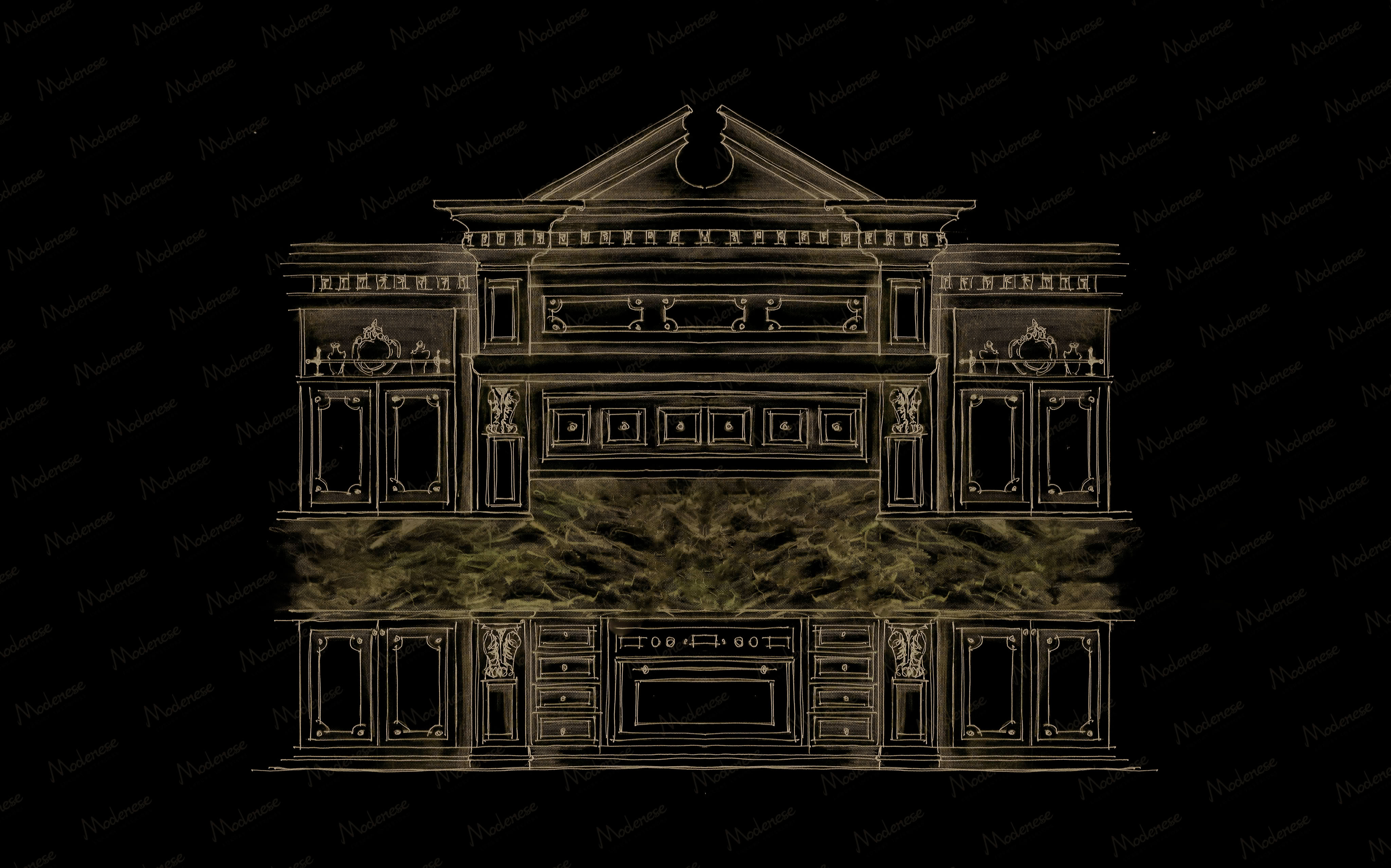
Patina finishing creates the appearance of aged, worn surfaces on new cabinetry. In the Modenese Luxury Classic and Romantic collections, patina is applied to carved mouldings, panel edges, and decorative elements to produce the visual depth that comes from decades of natural wear — without waiting decades.
The Patina Process
The base cabinet is first finished in the primary colour (typically an ivory, cream, or pale grey PU lacquer) and allowed to fully cure. The patina itself is a thinned glaze — pigmented lacquer or oil-based glaze reduced to a translucent consistency — in a contrasting tone. Common patina colours are raw umber, burnt sienna, Van Dyke brown, and grey-green (for a French-style aged look).
The glaze is brushed into all recesses, moulding profiles, carved details, and panel edges, then partially wiped away from the raised surfaces while still wet. The glaze remains heaviest in the concavities and transitions — the places where natural grime and wear would accumulate on a genuinely old piece. The craftsman controls the density and distribution of the glaze entirely by hand, using cotton rags, soft brushes, and sometimes a dry stippling brush to create variation that reads as organic rather than mechanical.
After the patina glaze has dried (2-4 hours for oil-based glazes, 30-60 minutes for lacquer-based), a light clear coat is applied over the entire surface to lock the patina in place and provide a consistent sheen. This clear coat is typically a matte or low-satin PU lacquer (5-15 gloss units) — higher gloss would look inconsistent with the aged aesthetic.
Durability and Maintenance
Because the patina sits beneath a protective clear coat, it is as durable as the clear coat itself. Normal kitchen cleaning with a damp cloth and mild soap will not disturb it. However, abrasive cleaners or aggressive scrubbing on moulding details can wear through the clear coat and into the patina layer, lightening the effect in those areas. The maintenance protocol is the same as for any PU-lacquered surface: clean with pH-neutral products, avoid abrasives, and apply a thin coat of microcrystalline wax once or twice per year to maintain the sheen and add an additional layer of surface protection.
Gold Leaf Application: Water Gilding vs. Oil Gilding
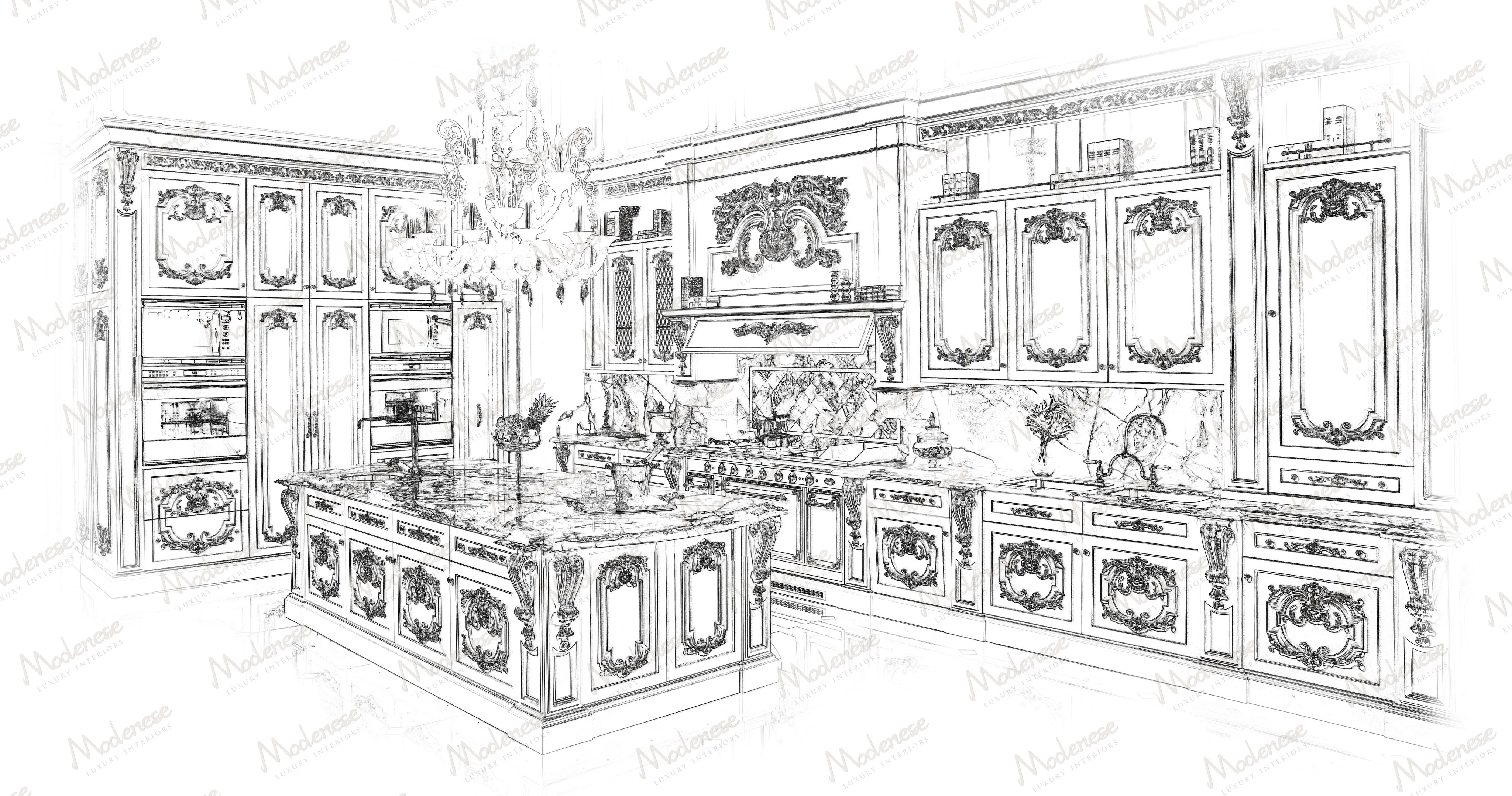
Gold leaf detailing on kitchen mouldings, corbels, and decorative capitals is a defining feature of the Royal collection. The two traditional gilding methods — water gilding and oil gilding — produce different visual results and have different durability characteristics in kitchen environments.
Water Gilding
Water gilding is the older and more labour-intensive technique. The surface to be gilded is first coated with multiple layers of gesso (a mixture of rabbit-skin glue and calcium carbonate), sanded smooth, then coated with bole — a clay-based pigment (traditionally Armenian red, yellow, or black) mixed with rabbit-skin glue. The bole is polished with an agate burnisher to a smooth, slightly glossy surface.
To apply the gold leaf, the bole surface is wetted with a mixture of water and a small amount of ethanol (to break surface tension). The gold leaf (typically 23-23.75 karat, in sheets approximately 80 x 80 mm and 0.1-0.2 microns thick) is laid onto the wet bole with a gilder’s tip (a flat brush of squirrel hair that picks up the leaf through static charge). As the water is absorbed by the bole, the gold leaf bonds to the surface through the adhesive properties of the reactivated glue in the bole layer.
The key advantage of water gilding is that it can be burnished. Once dry (typically 12-24 hours, depending on humidity), an agate burnisher is rubbed firmly over the gold surface, compressing the leaf into the bole and producing a brilliant, mirror-like reflectivity that oil gilding cannot achieve. Water-gilded and burnished surfaces have a luminosity that results from the gold being in direct optical contact with the smooth bole underlayer, with no adhesive film separating them.
Oil Gilding
Oil gilding uses a slow-drying adhesive (oil size, available in 1-hour, 3-hour, and 12-hour tack times) applied directly over a sealed and painted surface. The gold leaf is applied when the size has reached the correct tack — still sticky enough to hold the leaf but dry enough not to ooze through it. The leaf bonds to the size and, once the size fully cures, is permanent.
Oil gilding is faster, simpler, and more forgiving than water gilding. It can be applied over any sealed surface without the multiple gesso and bole preparation layers. However, oil-gilded surfaces cannot be burnished — the size layer prevents the compression that creates the mirror effect. The resulting finish is matte to satin rather than brilliant, with a softer, warmer gold tone.
In Modenese kitchens, water gilding is used on prominent, eye-level decorative elements (column capitals, carved rosettes, central moulding details on hood surrounds) where the burnished brilliance is visible and impactful. Oil gilding is used on less prominent areas (recessed moulding lines, background areas of carved panels, applied ornament on upper cabinet friezes) where the matte gold creates depth without competing with the burnished highlights.
How Cuisine Conditions Affect Finishes Over 10-20 Years
A kitchen finish must withstand conditions that would be considered hostile in any other furniture application: sustained temperatures of 30-40 degrees C near ovens and cooktops, humidity spikes to 80-90% RH during heavy cooking, grease-laden air that deposits a fine film on all surfaces, UV exposure from windows that can fade pigments, and daily cleaning with various chemical products.
Lacquer Performance
Polyester lacquer in high-gloss finishes will maintain its reflectivity for 15-20 years in a well-maintained kitchen. The primary degradation pathway is micro-scratching from daily cleaning — each wipe with a cloth (even a soft microfibre) leaves microscopic scratches that gradually reduce the gloss measurement from an initial 90+ GU to 70-80 GU over 10 years. This is perceptible as a slightly warmer, less liquid-looking gloss, but the surface remains intact and can be machine-polished back to near-original condition.
PU lacquer in satin finishes shows less visible aging because the surface is already designed to scatter light rather than reflect it sharply. The main concern over 15-20 years is yellowing: many PU clear lacquers (particularly those containing aromatic isocyanates) will develop a warm yellow cast when exposed to UV light over years. This is most noticeable on white and pale-coloured cabinets. Aliphatic PU lacquers resist yellowing significantly better but cost approximately 30-40% more than their aromatic equivalents. Modenese specifies aliphatic PU for all white and light-coloured kitchen finishes for this reason.
Patina Aging
Applied patina finishes, paradoxically, improve with age. The slight additional wear that occurs naturally around handles, on the lower edges of base cabinets, and on frequently touched surfaces adds to the aged character rather than detracting from it. After 10-15 years, a patina-finished kitchen develops a genuine layering of applied and natural aging that becomes increasingly convincing and attractive.
Gold Leaf Durability
Gold itself does not tarnish, corrode, or react with kitchen chemicals — it is among the most chemically inert materials used in any decorative application. The vulnerability is in the substrate and adhesive layers beneath the gold. Water-gilded surfaces in high-humidity environments (directly adjacent to a steaming cooktop, for example) can suffer bole softening if moisture penetrates the gold layer through any nick or gap. This causes localised lifting of the gold leaf, appearing as small blisters or areas where the gold flakes away to reveal the red bole beneath.
Oil-gilded surfaces are more moisture-resistant because the size adhesive is waterproof once cured. For this reason, gold leaf details on kitchen elements that are directly exposed to steam or splash — such as hood surrounds directly above a cooktop — are oil-gilded at Modenese regardless of their visual prominence, with water gilding reserved for areas at least 500 mm from any direct moisture source.
Maintenance Protocols by Finish Type
Each finish type requires a specific maintenance approach to maximise its lifespan. Applying the wrong maintenance product to a finish can cause more damage than neglect.
For high-gloss polyester lacquer: clean with a soft, damp microfibre cloth only. Never use scouring pads, abrasive cleaners, or products containing ammonia or bleach. Once per year, apply a professional furniture polish (carnauba-based, silicone-free) and machine-buff with a soft lamb’s-wool pad to restore gloss. Every 8-10 years, consider professional re-polishing (cutting compound and finishing polish) to remove accumulated micro-scratches.
For satin PU lacquer: clean with a damp cloth and pH-neutral soap solution. Twice per year, apply a thin coat of microcrystalline wax (Renaissance Wax or equivalent) with a soft cloth and buff lightly. This fills micro-scratches and maintains the intended sheen level. Avoid furniture sprays containing silicone, which build up over time and create a sticky surface that attracts dust.
For patina finishes: follow the PU lacquer protocol above, with the additional caution to avoid scrubbing moulding recesses where the patina glaze is thickest. Wax application on patina surfaces is particularly beneficial, as it darkens the recesses slightly and enhances the aged effect.
For gold leaf surfaces: dust with a soft, dry brush only — never use a damp cloth on gilded areas. If grease film accumulates on gold leaf near a cooktop, a barely-damp cotton swab can be used to clean individual areas, followed immediately by blotting dry. Never apply wax, polish, or any chemical product directly to gold leaf.
Understanding these finishing techniques helps architects and designers specify the right surface treatment for each area of a kitchen project. The relationship between solid wood substrate construction and surface finishing is direct: a well-prepared, dimensionally stable substrate is the foundation for any finish that needs to last decades. The same finishing expertise applies across Modenese product categories, from the lacquered panels in walk-in closets to the modular wardrobe systems and the specialised acoustic finishes in home cinema installations requiring integrated smart automation. For island kitchens where structural and ventilation planning affects finish durability, early coordination between the kitchen manufacturer and the project architect during the design phase is essential. Explorer finished projects in the kitchen projects gallery and view the full range of kitchen styles including the Deluxe Wood and Royal collections on the carpentry page.