Acoustic Panel Design in Luxury Home Cinemas: Wood, Fabric, and Diffusion Geometry
Acoustic Treatment Is Not Decoration — It Is Engineering That Happens to Be Visible
A private home cinema without acoustic treatment is a room with a screen in it. The sound from a properly specified speaker system bounces off hard surfaces — plaster walls, stone floors, glass elements — and arrives at the listener’s ear as a smeared, delayed version of the original signal. Acoustic panel design in a luxury home cinema solves this problem while maintaining the visual standard expected in a high-end residential interior. The panels must absorb specific frequencies, diffuse others, and do both using materials that belong in a finished room rather than a recording studio.
This article covers the physics and material science behind three categories of acoustic treatment: fabric absorbers, wood diffusers, and bass traps — with calculations and material specifications relevant to residential cinema rooms sized between 25 and 80 square meters.
Fabric Absorbers: Material Selection by Frequency Response
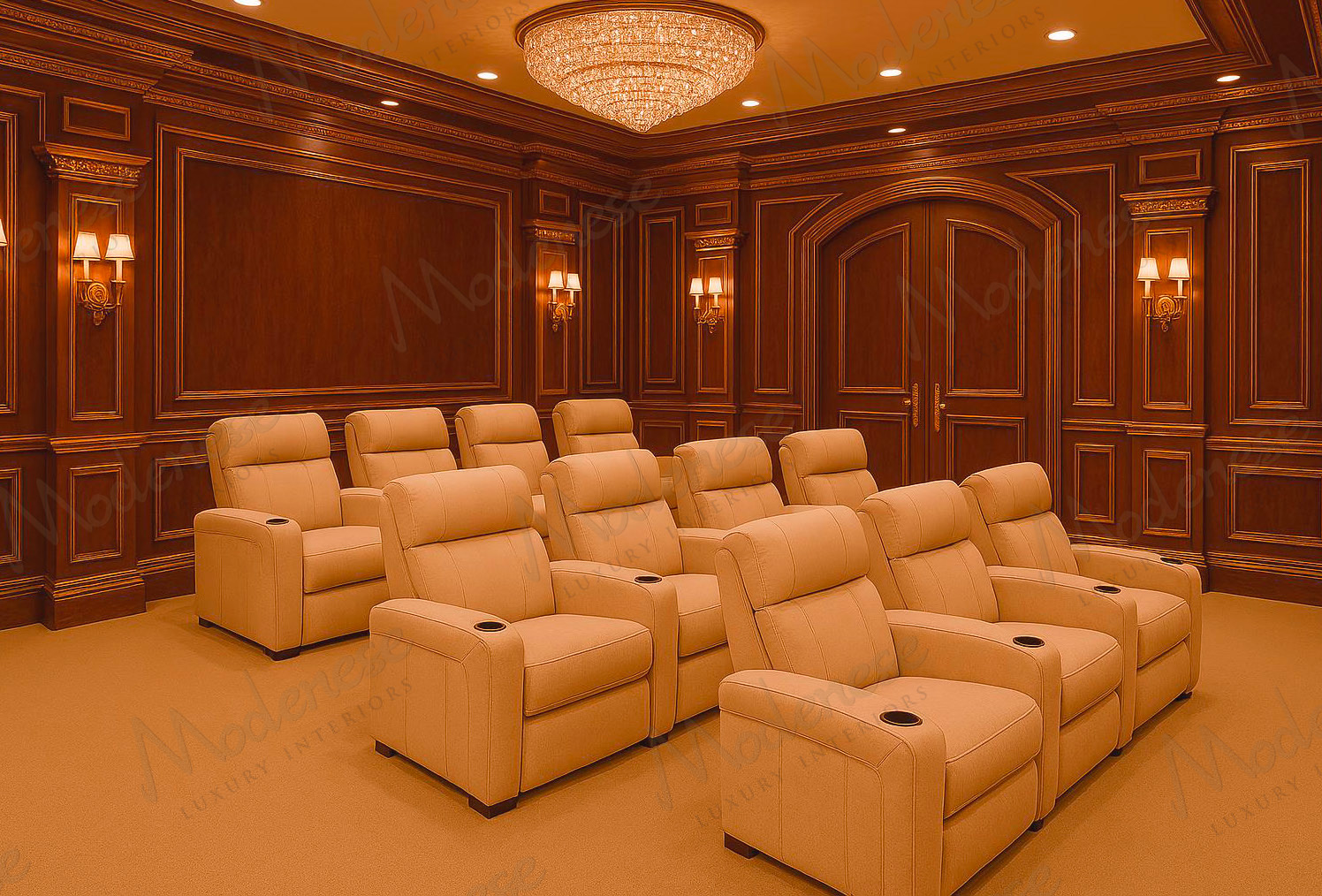
Fabric-covered absorptive panels are the primary tool for controlling mid and high-frequency reflections (500Hz-4000Hz). The acoustic performance depends on the absorptive core material and its thickness, not the fabric covering — the fabric’s role is purely visual, provided it meets a minimum air permeability threshold.
Core Materials
Mineral wool (rock wool, 40-60 kg/m3 density) is the standard core material. At 50mm thickness, a mineral wool panel achieves an absorption coefficient of approximately 0.85 at 1000Hz and 0.95 at 2000Hz. At 100mm thickness, absorption at 500Hz improves from 0.55 to 0.80 — a significant gain in the critical vocal clarity range.
Polyester fiber panels (recycled PET, 30-40 kg/m3) offer comparable absorption above 1000Hz but underperform mineral wool below 500Hz at equivalent thicknesses. Their advantage is handling safety — no skin irritation during installation, no fiber release into the room air. For cinemas in residential settings where the room also serves occasional other functions, PET panels are a practical choice.
Fabric Covering
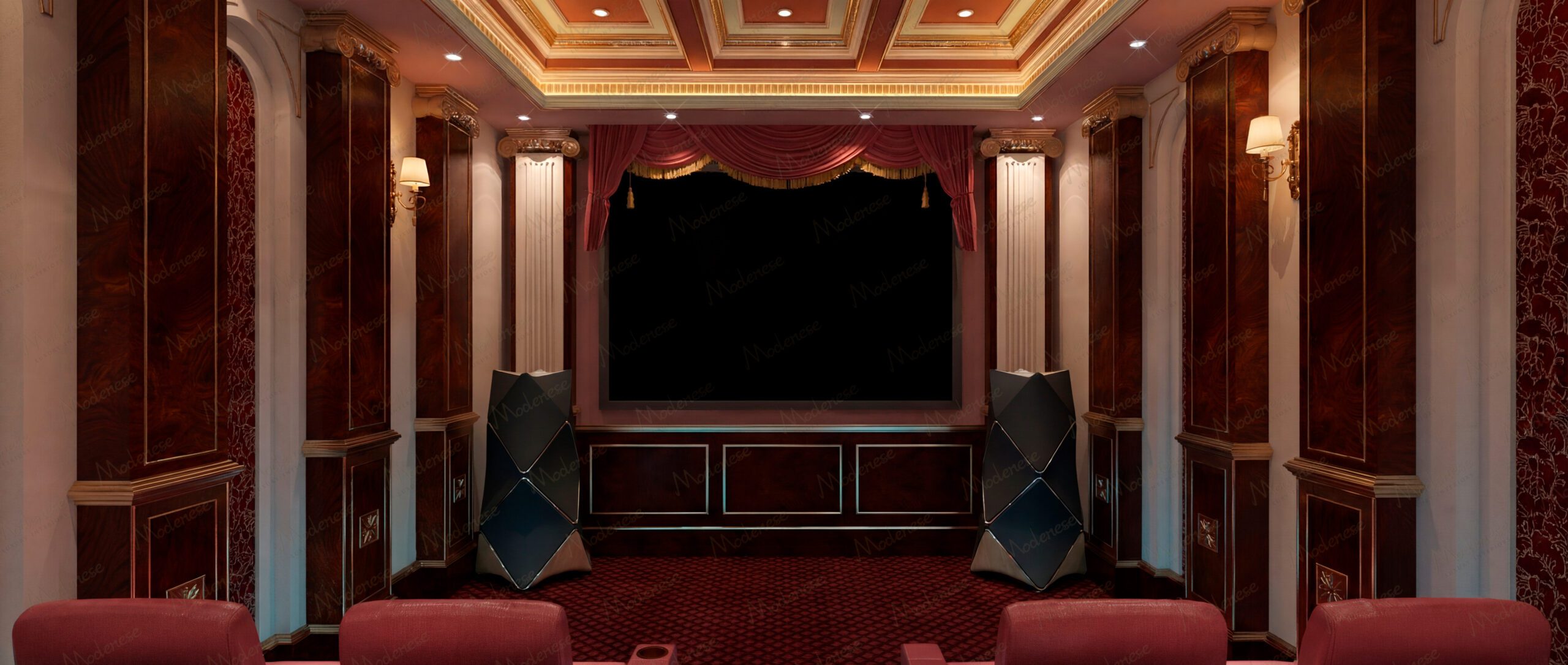
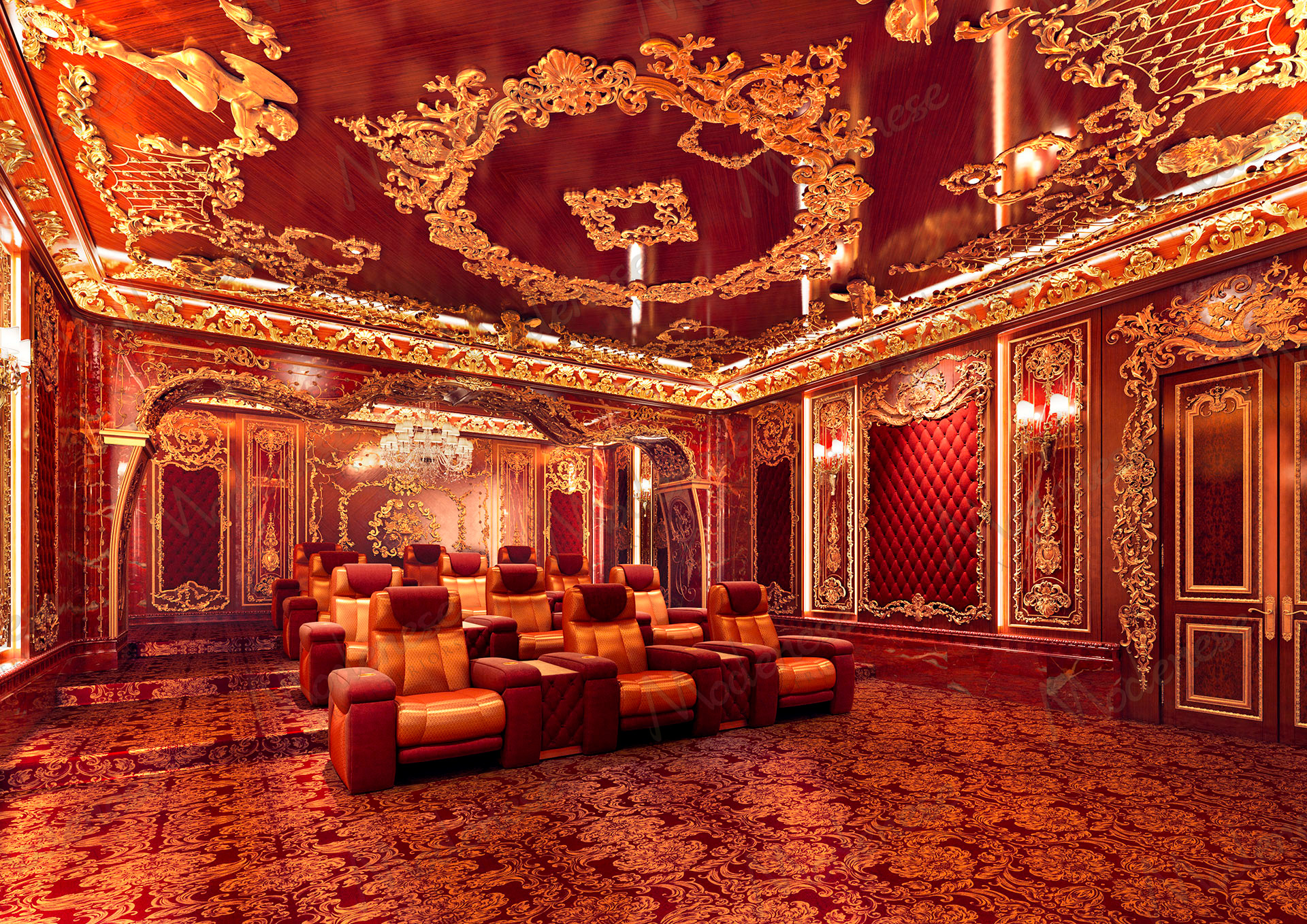
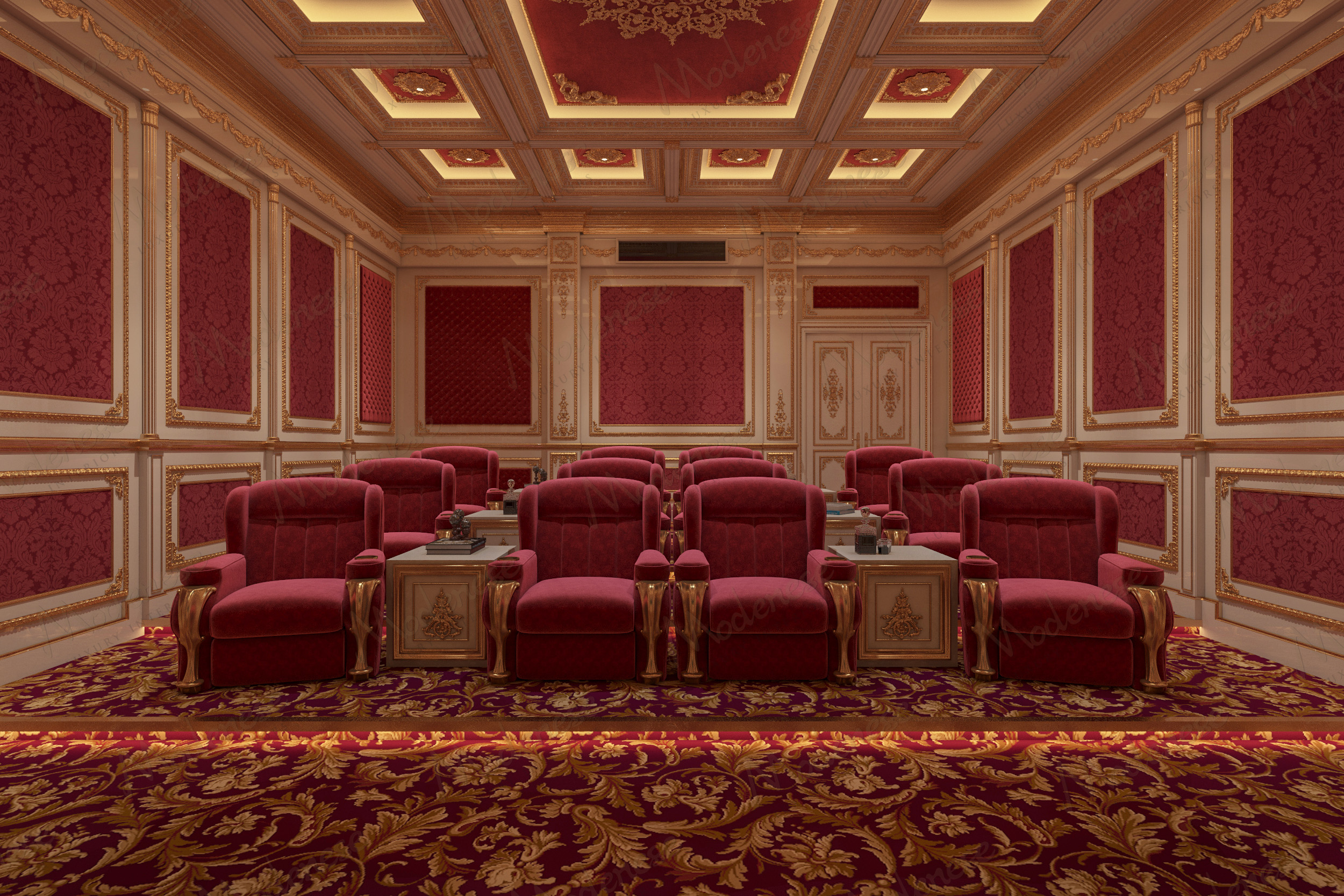
Acoustically transparent fabric must have an air flow resistance below 200 MKS Rayls. Standard speaker grille cloth meets this specification. Wool blends and open-weave linens also qualify. Tightly woven silk, leather, and vinyl are acoustically opaque — they reflect sound rather than passing it through to the absorber behind. In a traditional classic theater where the aesthetic requires rich fabric textures, use wool velvet (typically 150-180 MKS Rayls) rather than synthetic velvet (often 250+ MKS Rayls).
Wood Slat Diffusers: Geometry That Scatters Sound Predictably
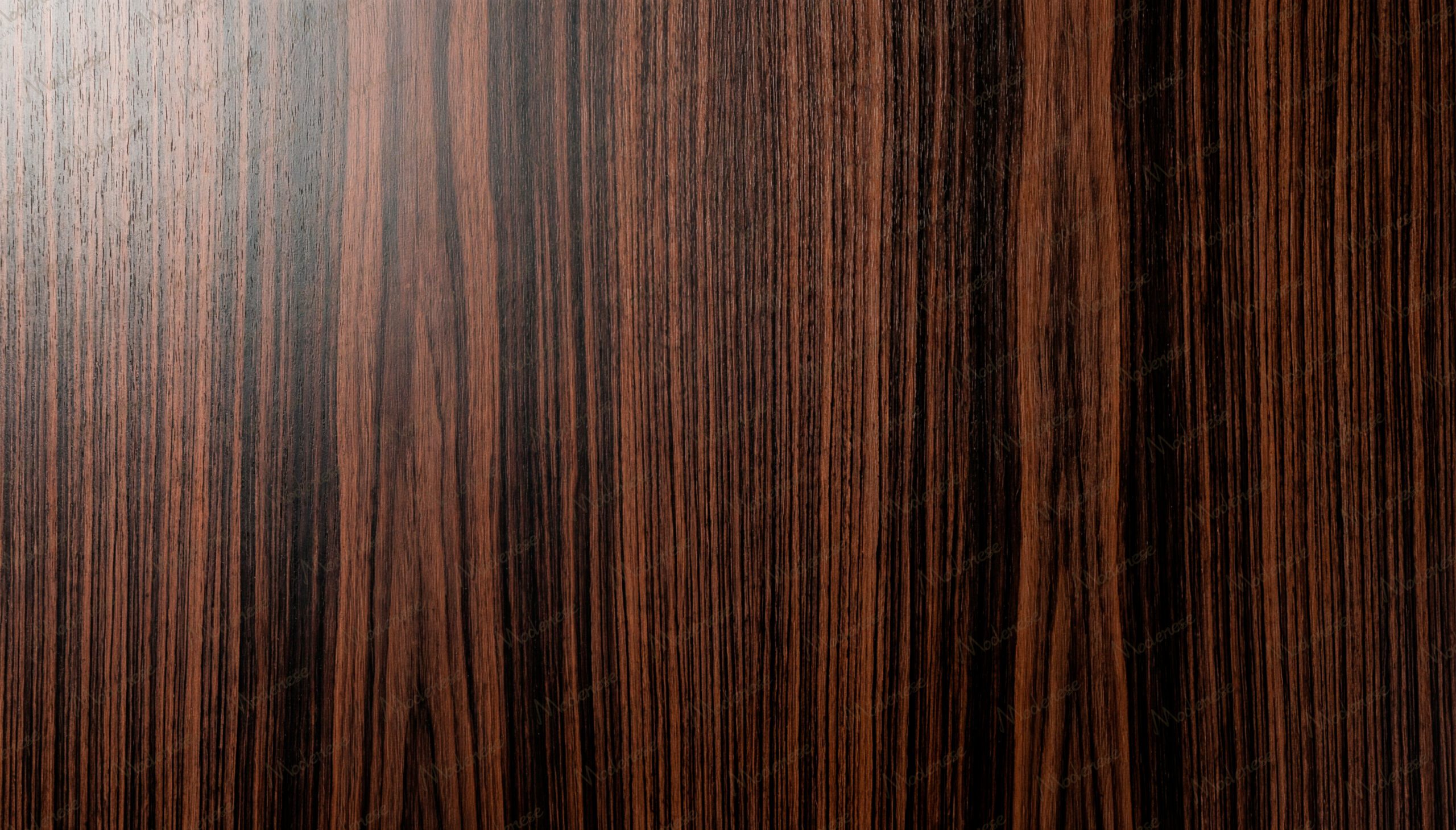
Diffusers scatter reflected sound across a wide angle rather than absorbing it. This preserves the room’s acoustic energy (keeping the space from feeling dead) while eliminating focused reflections that cause comb filtering and image smearing at the listening position.
QRD (Quadratic Residue Diffuser) Design
A QRD uses wells of varying depth behind a slat face. The well depths are calculated from a quadratic residue sequence based on a chosen prime number. For a cinema optimized for diffusion between 500Hz and 4000Hz, a QRD based on prime 7 with a design frequency of 1900Hz produces wells with depths ranging from 0mm to approximately 90mm. The slat width is typically equal to the well width — between 25mm and 40mm for this frequency range.
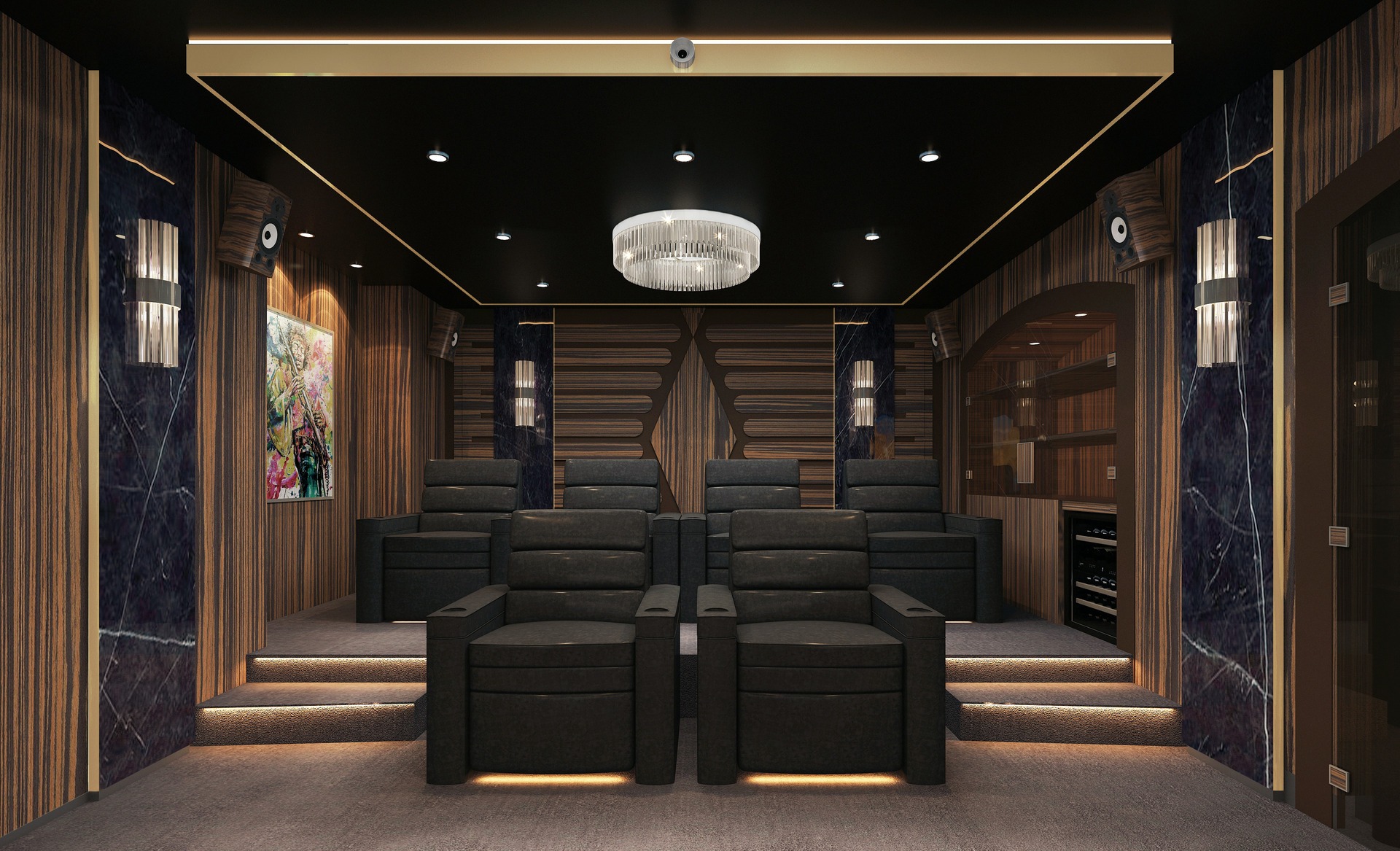
The total diffuser depth (deepest well plus back panel) reaches 120-140mm. This is a substantial projection from the wall, which affects room dimensions. In a Makassar modern cinema with clean geometric lines, the diffuser panels become an architectural feature — the varying depth creates a rhythmic surface pattern that reads as intentional design rather than acoustic correction.
Material Selection for Slats
Slats must be rigid enough to reflect sound without resonating. Solid hardwood (oak, walnut, ash) at 15mm minimum thickness meets this requirement. MDF slats work acoustically but lack the grain texture that makes wood diffusers visually interesting. For the classical baroque cinema, carved or moulded slat profiles add visual complexity while maintaining the geometric precision required for proper diffusion.
Bass Traps: Managing the Lowest Frequencies
Frequencies below 200Hz accumulate in room corners where walls, floor, and ceiling intersect. These standing waves create zones of exaggerated bass (at pressure nodes) and bass cancellation (at velocity nodes) that no amount of subwoofer equalization can fully correct. Physical bass trapping is required.
Porous absorber bass traps (mineral wool, 100-150mm thick, placed across room corners at 45 degrees) begin absorbing effectively around 125Hz. Thicker traps (200mm) extend absorption down to approximately 80Hz. Below 80Hz, porous absorption becomes impractical — the required panel thickness exceeds 300mm.
Membrane (diaphragmatic) bass traps use a tuned panel that resonates at a target frequency and converts acoustic energy to heat through internal damping. A 12mm MDF front panel over a 100mm sealed air cavity tuned to 63Hz absorbs effectively from 40-100Hz. These traps are compact (150mm total depth) and can be concealed behind a fabric-covered frame that matches the room’s other acoustic panels. Placement: one in each of the four vertical room corners, and optionally in the wall-ceiling junctions along the side walls.
RT60 Targets and Room Balance
RT60 measures the time required for sound to decay by 60dB after the source stops. For a home cinema, the target is 0.3-0.5 seconds across the 250Hz-4000Hz range. Below 0.3s, dialogue sounds dry and unnatural. Above 0.5s, spatial effects in film soundtracks lose precision — explosions bleed into dialogue, ambient sounds overlay each other.
A room with all hard surfaces (plaster walls, hardwood floor, plastered ceiling) typically measures RT60 of 1.2-1.8 seconds. Reducing this to the 0.3-0.5s target requires treating approximately 40-60% of the room’s surface area with absorptive material. The rear wall and side walls at the first reflection points are the priority surfaces. The ceiling above the seating area is the third priority. The front wall behind the speakers receives minimal treatment — the speakers need a reflective surface behind them for proper bass loading.
The seating layout that works hand-in-hand with acoustic treatment is covered in our seating layout engineering guide, where row spacing and platform design interact directly with rear-wall treatment placement. The control system automation that manages pre-show acoustic curtain positioning is detailed in our smart automation guide.
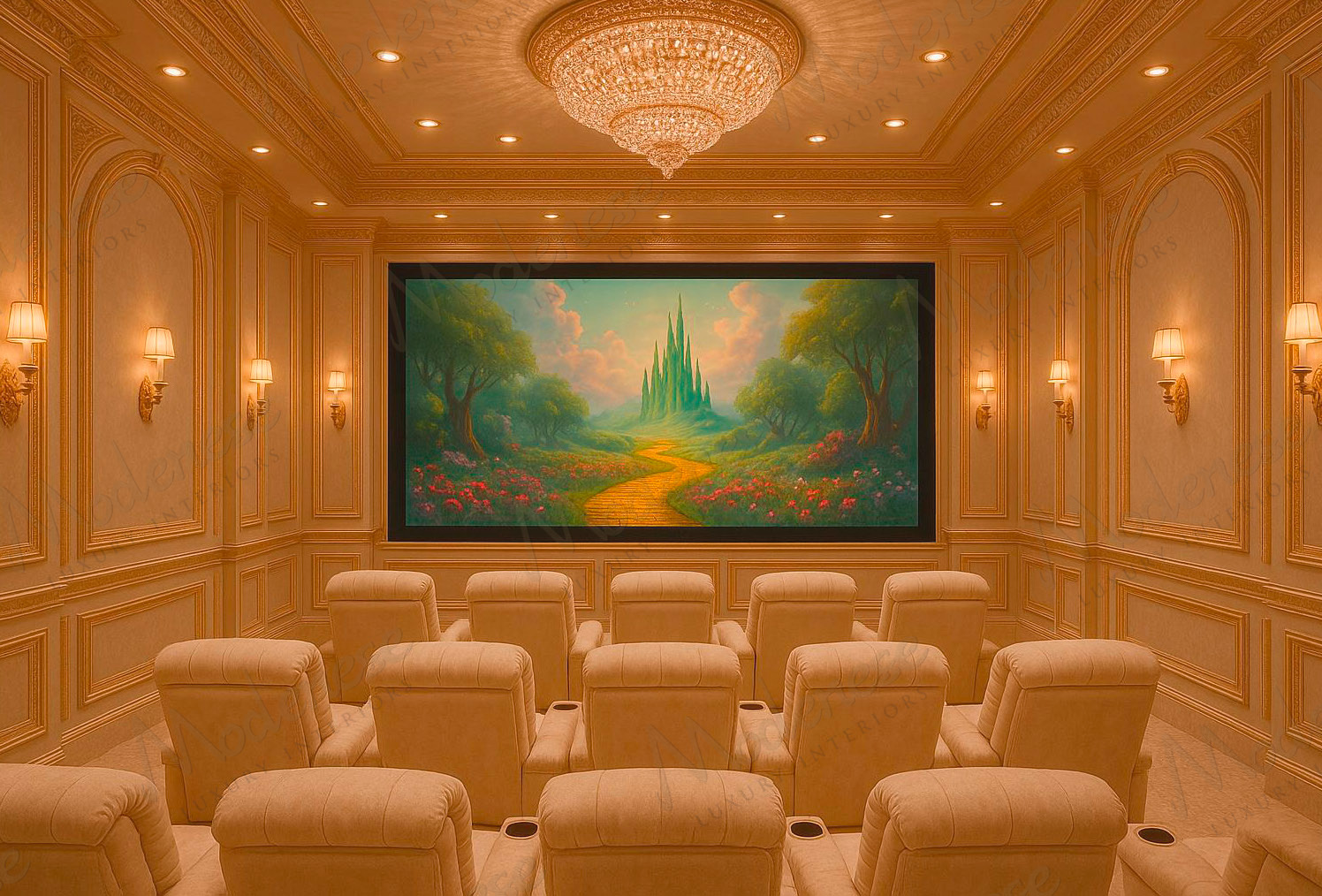
The same carpentry techniques used to build precision wood diffuser panels apply to the moulding and panel work in Italian kitchen cabinetry and walk-in closet construction — the tolerances differ, but the materials and joinery methods share common roots in the Modenese workshop. Acoustic panel frames and diffuser slats are manufactured with the same CNC routing and hand-finishing protocols used across all bespoke interior projects — as discussed in our solid wood construction guide for kitchens.