How Solid Wood Construction Defines the Lifespan of a Handmade Italian Kitchen
A handmade Italian kitchen built from solid wood will outlast any engineered-board alternative by decades — but only if the wood species, joinery, and finishing are selected and executed correctly. At Modenese Bespoke, every kitchen begins with the selection of kiln-dried European hardwoods, and the construction methods that follow determine whether the piece will serve a family for 20 years or for 80. This article examines the specific technical factors that separate a solid wood kitchen built to last from one that merely looks the part.
Wood Species Selection: Mechanical Properties That Matter in Kitchen Environments
Not all hardwoods perform equally in the demanding environment of a kitchen, where surfaces face heat cycling from ovens, steam from boiling water, and regular contact with water and oils. The four species most commonly used in Modenese kitchens — European walnut (Juglans regia), white oak (Quercus petraea), wild cherry (Prunus avium), and European ash (Fraxinus excelsior) — each bring distinct structural characteristics.
European Walnut
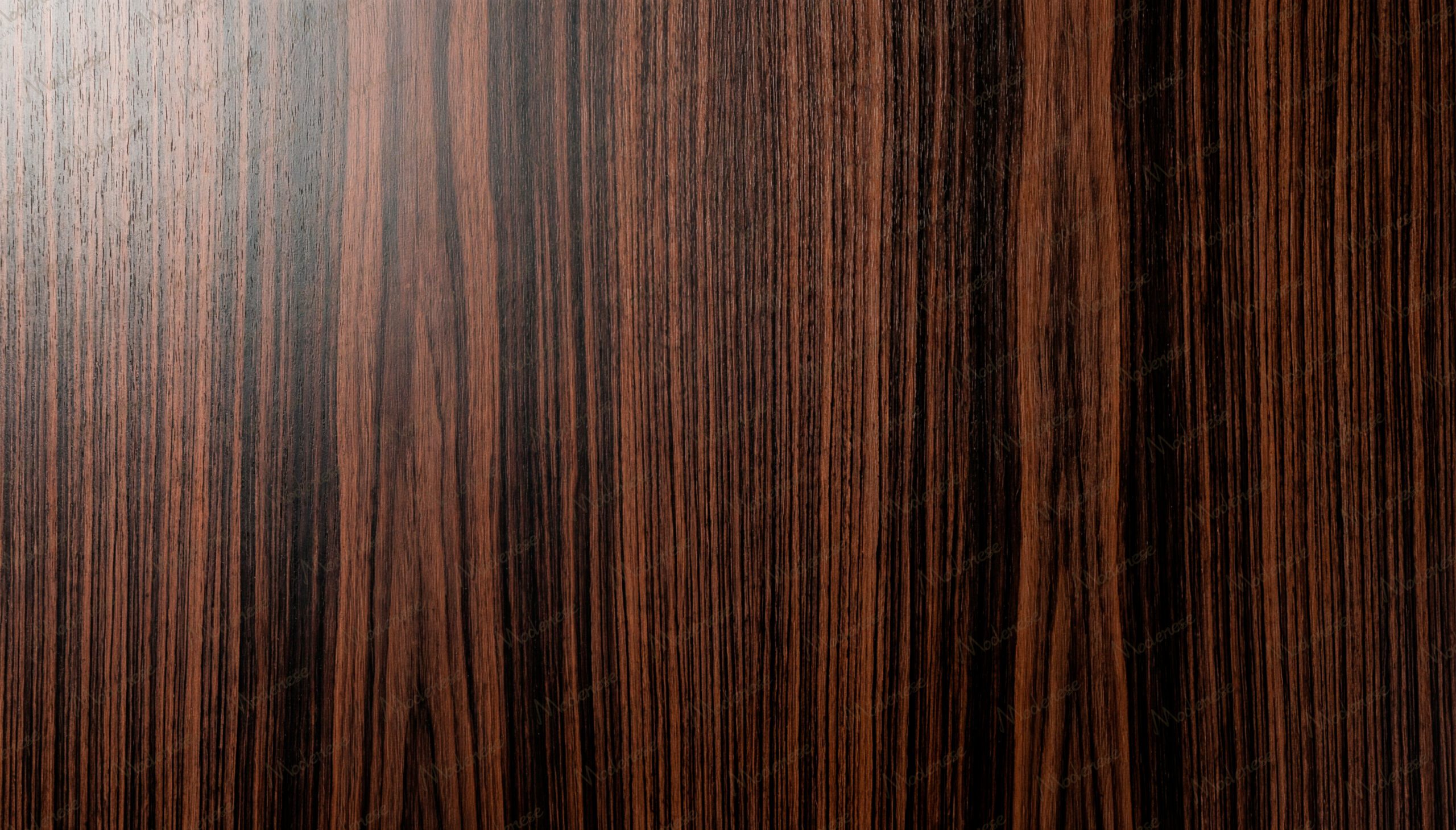
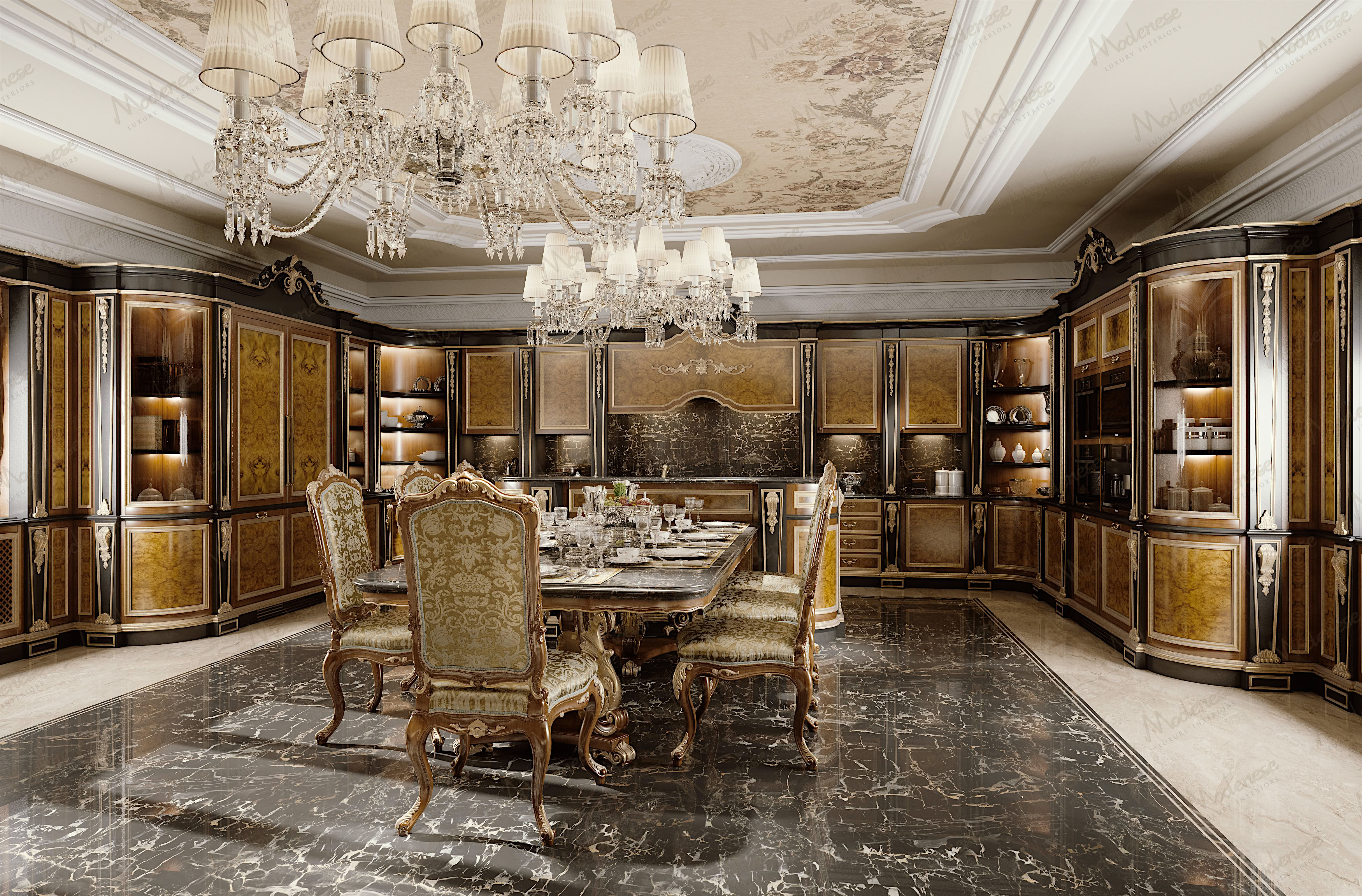
Walnut offers a Janka hardness of approximately 1,010 lbf (4,490 N), placing it in the mid-range for cabinet construction. Its real advantage is dimensional stability: its tangential-to-radial shrinkage ratio sits at 1.4:1, among the lowest of any European hardwood. This means walnut panels and doors resist warping and seasonal movement better than most alternatives. The open-pore grain structure accepts oil finishes deeply, building a surface that improves with age. Walnut is the primary species in the Deluxe Wood collection, where its chocolate-to-amber tonal range provides visual warmth without requiring heavy staining.
White Oak
With a Janka hardness of 1,360 lbf (6,050 N), white oak is the most mechanically robust option for kitchen cabinetry. Its closed-cell tyloses make it naturally resistant to moisture penetration — the same property that makes it suitable for wine barrels and boat building. For kitchens in humid climates or near coastal environments, white oak offers the best protection against swelling and fungal degradation. Quarter-sawn white oak, cut perpendicular to the growth rings, produces the distinctive medullary ray figure (sometimes called tiger stripe) and reduces tangential movement to under 2.5% across a full seasonal humidity cycle.
Wild Cherry
Cherry is the softest of the four species at roughly 950 lbf (4,230 N) Janka hardness, but it compensates with exceptional workability and a grain structure that takes lacquer finishes to a mirror-smooth surface with minimal grain filling. Cherry darkens substantially under UV exposure — shifting from pale salmon to a deep reddish-brown within 6-12 months — which should be factored into the design timeline. New cherry doors installed next to doors that have aged for even a few weeks will show visible colour difference until the wood reaches its mature tone. This species features prominently in the Romantic collection, where its warmth pairs with curved moulding profiles.
European Ash
Ash delivers the highest bending strength of the group (MOR of approximately 103 MPa), making it the preferred choice for long, unsupported spans such as open shelving and cantilevered breakfast bars. Its pronounced, cathedral-like grain pattern creates visual interest without applied decorative techniques. Ash accepts both staining and bleaching treatments well, giving it the widest aesthetic range. However, its open-pore structure requires thorough sealing in areas exposed to water splash zones.
Joinery Methods: Where Structural Integrity Is Won or Lost
The joints in a kitchen cabinet bear more stress than those in almost any other piece of furniture. Cabinets must support stone countertops weighing 20-30 kg per linear metre, resist the repeated impact of closing doors thousands of times per year, and maintain alignment despite seasonal wood movement. The joinery method determines whether these stresses result in gradual failure or are absorbed without degradation.
Mortise-and-Tenon in Face Frames and Door Construction
The mortise-and-tenon joint, where a projecting tenon on one piece fits into a rectangular pocket cut into another, provides the highest mechanical strength of any wood-to-wood connection. In kitchen door frames, the tenon is typically cut to one-third the thickness of the rail stock (for 22 mm stock, a 7 mm tenon) and extends 25-30 mm into the stile. When glued with PVA or polyurethane adhesive and reinforced with a hardwood dowel pin, this joint achieves a tensile strength exceeding 3,000 N — roughly six times the load it will ever experience in normal use.
At Modenese, mortise-and-tenon joints are CNC-cut to tolerances of +/-0.1 mm, then hand-fitted. The CNC cutting ensures geometric precision that hand-cutting alone cannot reliably achieve across a production run of 40-60 doors. The hand-fitting step — where a craftsman tests each joint dry, adjusts the fit with a shoulder plane if needed, and controls glue application — ensures the kind of tight, even contact that maximises glue-surface area and prevents squeeze-out from marring the visible face.
Dovetail Joints in Drawer Construction
Drawer boxes experience a unique stress profile: they must resist pulling forces every time the drawer is opened. Through-dovetail joints, where interlocking trapezoidal pins and tails are visible on both faces, provide mechanical locking that prevents the joint from pulling apart even if the glue fails entirely. A well-cut dovetail with a 1:6 pin angle (approximately 9.5 degrees) in hardwood will resist pull-apart forces exceeding 5,000 N.
For kitchen drawers that carry heavy loads — cutlery drawers, pot drawers, bottle drawers — half-blind dovetails at the front (where the joint is hidden behind the drawer face) combined with through-dovetails at the rear provide the strongest possible construction. The drawer bottom sits in a groove ploughed into the front and sides, floating without glue to allow for cross-grain expansion, and is pinned to the rear panel with a single screw in a slotted hole.
Tongue-and-Groove and Floating Panels
Solid wood panels in door centres and side panels must be free to expand and contract with humidity changes. A 400 mm wide walnut panel can move 3-4 mm across its width between winter and summer in a heated European home. If this panel is glued or screwed rigidly into its frame, the result is split panels or buckled frames within two to three years. The correct approach is a floating panel seated in a groove (typically 10 mm deep, 6 mm wide) with 2 mm clearance on each side, held in place without adhesive. Silicone-tipped space balls seated in the groove prevent the panel from rattling while still allowing movement.
Seasoning and Kiln-Drying: The Invisible Foundation
The moisture content of wood at the time of construction determines its long-term stability more than any other single factor. Freshly felled European hardwood contains 40-80% moisture content by weight. Kitchen cabinetry installed in a heated interior must be constructed from wood at 8-10% MC to match the equilibrium moisture content of the room (typically 35-55% relative humidity, corresponding to 7-11% MC in wood).
Air drying alone reduces MC to approximately 15-20%, depending on local climate, over a period of 1-2 years per 25 mm of thickness. Kiln drying then brings the wood to the target 8-10% MC in a controlled schedule that typically runs 2-4 weeks for 27 mm hardwood stock. The kiln schedule matters: too-rapid drying creates case hardening, where the outer shell dries and locks in compression while the core remains wet. When the core eventually dries, internal tension causes honeycomb checking — internal cracks invisible from the surface that weaken the wood structurally.
Modenese sources timber that has been air-dried for a minimum of 12 months before kiln drying. After kiln drying, the stock is acclimatised in the workshop at 45-55% RH for a minimum of two weeks before machining. Boards are stickered (stacked with spacer strips between each layer) to allow air circulation on all faces. Moisture content is verified with a pin-type moisture meter at multiple points along each board before it enters production. Any board reading above 10% or below 7% is rejected or returned to the conditioning stack.
Grain Orientation and Panel Layout: Engineering Against Wood Movement
Wood moves. This is not a defect; it is a physical reality that must be designed around rather than resisted. Tangential movement (parallel to the growth rings) is approximately twice radial movement (perpendicular to the growth rings), and longitudinal movement (along the grain) is negligible — typically under 0.1% across any realistic humidity range.
In frame-and-panel door construction, the frame rails and stiles are oriented with their grain running along their length, which means the overall door dimensions remain stable in the critical height and width directions. All expansion and contraction occurs in the floating centre panel, which has the freedom to move within its groove. This is why a solid wood kitchen door, properly built, will never bind in its hinges or leave gaps at its edges — the frame simply does not move enough to matter.
For wide panels such as kitchen island sides or tall pantry cabinet ends, boards are edge-glued with alternating growth ring orientation (one board with rings curving up, the next with rings curving down). This technique, called balanced panel construction, causes opposing cupping forces to cancel each other out, producing a panel that remains flat even as individual boards try to cup. The glue joints in a properly prepared edge-glued panel (jointed flat and square, glued with PVA under 700-900 kPa clamping pressure) are stronger than the surrounding wood — the panel will break along the grain before it fails at the glue line.
CNC Precision Paired with Hand Finishing: Why the Hybrid Approach Wins
The debate between fully handmade and fully industrial kitchen production misses the point. Each method has specific strengths, and a kitchen that combines both outperforms either approach used alone.
CNC machining excels at operations requiring geometric precision and repeatability: cutting mortises and tenons to +/-0.1 mm, routing hinge cup holes to exact depth, boring shelf-pin holes on precise 32 mm system spacing, and profiling complex mouldings consistently across dozens of identical components. A five-axis CNC router can execute a compound-curve bracket profile that would take a skilled carver two hours in under four minutes, and every bracket in a run of 30 will be identical to within 0.05 mm.
Hand work excels at operations requiring judgment and tactile feedback: fitting joints where wood grain variation means a theoretically perfect CNC joint needs a few strokes of a plane for optimal contact; blending sanding scratches across a curve where a machine sander would create flat spots; applying and rubbing out a hand-finished lacquer surface to the specific sheen a client has approved; and hand-carving decorative details where the slight irregularity of hand work gives life and movement that CNC carving lacks.
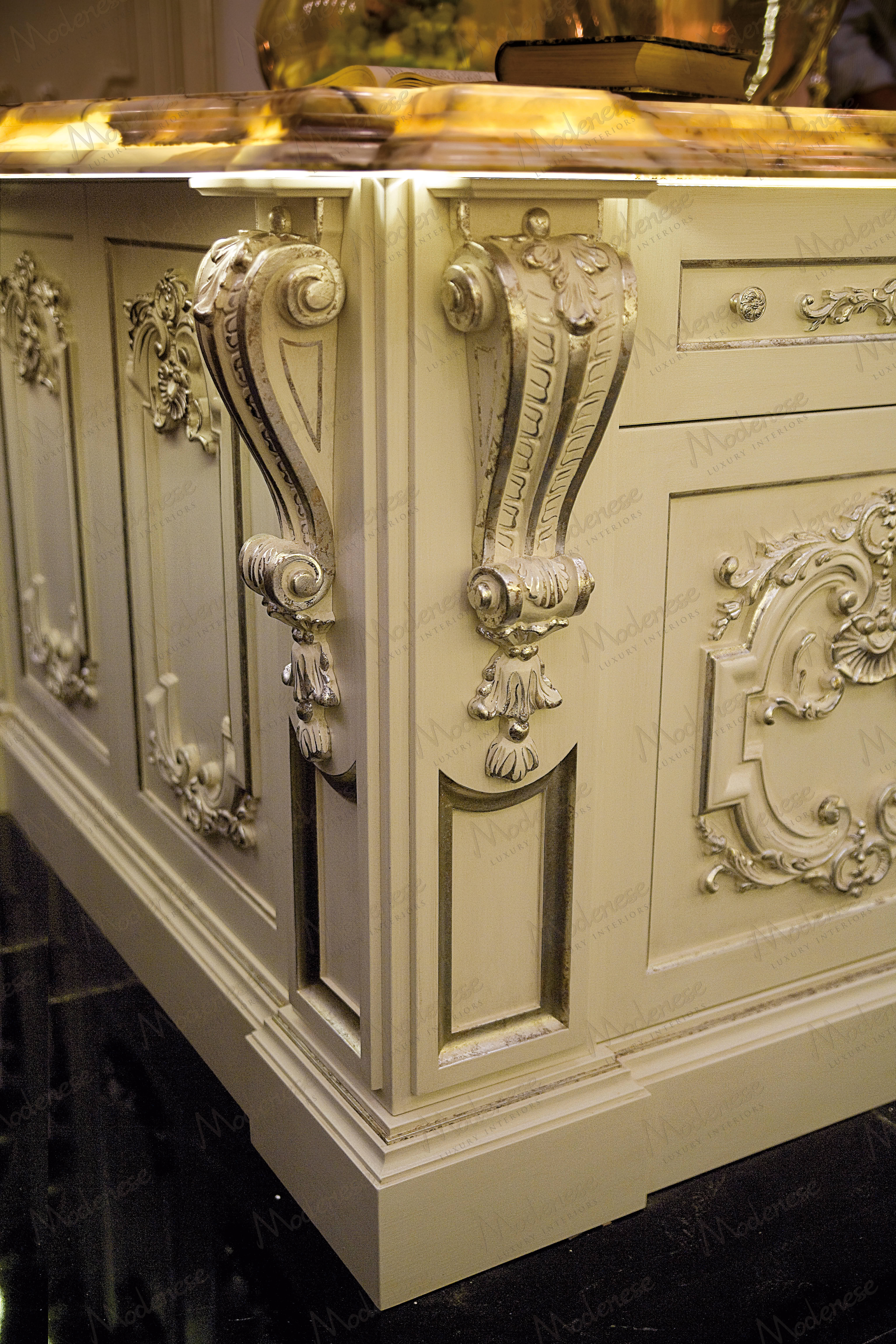
In the Modenese Royal and Luxury Classic collections, this hybrid approach is most visible in the carved column capitals and corbels: the primary form is CNC-roughed from a 3D model, then a carver refines the surface, undercuts leaves and scrolls, and adds the final texture with gouges and riffler files. The result is geometrically accurate to the drawings while retaining the hand-carved quality that distinguishes a bespoke kitchen from a production one.
This same logic extends to finishing. CNC-sanded components arrive at the finishing department with a uniform 180-grit surface. Hand sanding progresses through 240, 320, and 400 grit, with the craftsman adjusting pressure and direction to follow grain variations and soften arrises (sharp edges) to the 1-2 mm radius that feels comfortable under the hand. The difference between a kitchen that has been through this hand-finishing process and one that has not is immediately apparent to touch, even when the eye cannot identify the specific difference.
For architects and interior designers specifying Modenese kitchens for residential projects, understanding these construction fundamentals informs better design decisions — from island kitchen structural planning to the overall design process. The same principles of solid wood construction apply across all Modenese product lines, including bespoke walk-in closets and the architectural woodwork in home cinema installations, where the lighting design for wardrobes and acoustic panel construction rely on identical standards of timber selection and joinery. Explore completed installations in the kitchen projects gallery and learn about the workshop behind the work on the carpentry page.